
Organizations today have more data than ever.
Finance teams have spreadsheets. Treasury departments have transaction files. Accounting teams have general ledger extracts. Management has budgets, forecasts and dashboards. Banks have enormous volumes of financial and operational information spread across multiple systems.
Yet having data is not the same as having decision-ready data.
Before analytics, forecasting or artificial intelligence can provide meaningful answers, something much more fundamental needs to happen.
The data needs to be understood.
The Problem Usually Starts Before the Analysis
Consider a relatively simple situation.
A finance manager receives an Excel file containing thousands of transactions and wants to understand what is happening.
The first questions are rarely analytical ones.
Instead, they are practical:
Which column contains the transaction date?
Which field represents the amount?
Are there duplicate transactions?
Are some values missing?
Why is one department written three different ways?
Is the counterparty field reliable?
Are amounts stored consistently?
Are there several worksheets containing related information?
Can this dataset actually be used for the analysis being requested?
Before sophisticated analytics can begin, somebody has traditionally had to answer these questions manually.
That is where a surprising amount of analytical work actually occurs.
From Data Cleaning to Data Intelligence
Traditional data preparation is often described as data cleansing.
That remains important.
Duplicates should be identified. Column names may need normalization. Missing values need to be highlighted. Dates, numbers and categories must be interpreted correctly. Inconsistencies need to be identified.
But modern financial intelligence should go further.
A system should not simply ask:
“How should I clean this file?”
It should also begin asking:
“What does this data appear to represent?”
And ultimately:
“What is the user trying to achieve with it?”
Those are very different questions.
If the objective is forecasting, the system may need to identify dates, historical values, frequency and potential drivers.
If the objective is reconciliation, it may need transaction references, amounts, dates and potential matching fields.
If the objective is anomaly analysis, it may need to understand transaction behavior, counterparties, timing, frequency and unusual values.
If the objective is budgeting, the important fields may instead be departments, cost centers, periods, actuals and budget values.
The same dataset can therefore have very different meanings depending on the intent of the user.
Intent Should Drive Analytics
This is becoming increasingly important as organizations adopt AI.
Many systems still require users to understand the system before they can use it.
They must select the correct module, prepare a particular template, rename columns, restructure files and understand exactly what the analytical engine expects.
We believe the direction should increasingly be the opposite:
Don’t make the user learn the system. Make the system understand the user.
A user should increasingly be able to provide their data, explain what they want to accomplish and allow an intelligent preparation layer to help determine what happens next.
The system can inspect the information.
It can identify probable field roles.
It can assess data quality.
It can highlight issues.
It can recommend mappings.
It can determine whether the available information appears suitable for the intended analysis.
And importantly, it can allow the user to confirm or override those recommendations.
That combination of machine intelligence and human control is critical in finance.
Cleaning Data Should Not Mean Silently Changing It
Automation introduces another important issue: governance.
An intelligent system should not simply “fix” financial data without explaining what it has done.
If two exact duplicate records are removed, that should be recorded.
If column names are standardized, that should be visible.
If missing information is detected, the system should not automatically invent values merely to make the dataset complete.
Every important transformation should be explainable.
The user should be able to understand:
What was received → What was identified → What was changed → What remains unresolved → What is ready for analysis.
This creates something much more valuable than a cleaned spreadsheet.
It creates a controlled analytical starting point.
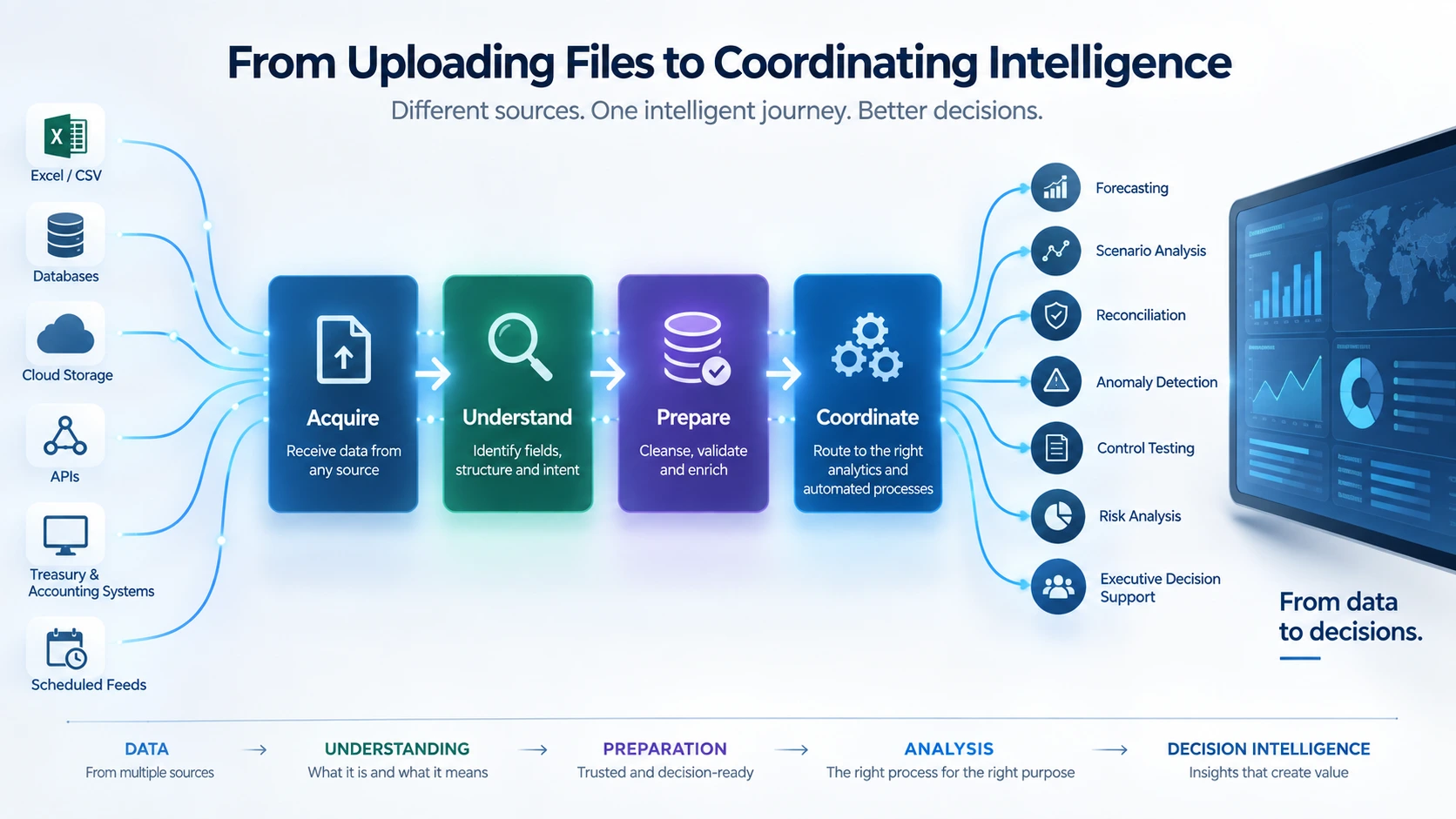
From Uploading Files to Coordinating Intelligence
This also changes how we should think about uploading data.
Uploading an Excel or CSV file is only one possible beginning.
Tomorrow's financial intelligence environment may receive information from databases, APIs, cloud storage, accounting platforms, treasury systems or scheduled data feeds.
Regardless of the source, the underlying requirement remains similar.
The information must be acquired, understood, validated and prepared before it is passed to an analytical process.
That process might ultimately involve:
forecasting,
scenario analysis,
financial planning,
reconciliation,
control testing,
anomaly detection,
risk analysis,
or executive decision support.
This is where automation becomes particularly powerful.
Instead of repeating the same preparation exercise every week or every month, approved processes can eventually become recurring workflows.
Data arrives.
Quality is checked.
Exceptions are identified.
The appropriate analytical process is selected.
Results are produced.
Management is notified when something requires attention.
The objective is not automation for its own sake.
The objective is to remove repetitive preparation work while keeping people responsible for the decisions that matter.
Why This Matters for Treasury TradingHub
This thinking is becoming an increasingly important part of the development philosophy behind Treasury TradingHub.
Our objective is not simply to build individual analytical tools.
We are working toward an environment where financial information can move through a more intelligent journey:
Data → Understanding → Preparation → Analysis → Decision Intelligence.
Forecasting engines should remain good at forecasting.
Scenario engines should remain good at testing assumptions.
Control and anomaly tools should remain focused on identifying issues requiring investigation.
Decision tools should remain focused on helping management interpret alternatives.
But increasingly, those capabilities should share an intelligent foundation that understands the information being provided and helps determine where it should go.
That is a very different model from simply adding another dashboard to an organization.
AI Needs Good Foundations
There is enormous enthusiasm today about generative AI, agents and autonomous workflows.
Much of it is justified.
But financial organizations cannot simply place an AI layer over inconsistent data and expect reliable intelligence.
The foundations still matter.
Data quality matters.
Context matters.
Intent matters.
Validation matters.
Governance matters.
And human oversight matters.
The most valuable financial AI systems may therefore not be those that produce the most impressive answer in seconds.
They may be the systems that quietly ensure the right data reaches the right analytical process for the right reason — with a clear understanding of what happened along the way.
That is where analytics begins to become intelligence.
And where intelligence can ultimately become better decisions.
Treasury TradingHub LLC
AI-powered financial intelligence for treasury, finance, risk and decision-making.