
Last week, I was in Kuwait conducting a treasury and risk management program.
The discussions were insightful, the participants highly engaged, and one theme appeared repeatedly throughout the sessions.
Many organizations possess more historical data than ever before.
Yet despite having dashboards, reports, spreadsheets, and performance reviews, decision-makers still face the same challenge:
"What happens next?"
Financial statements explain where we have been.
Management reports explain what happened.
Audit reports explain what went wrong.
But none of them, by themselves, explain what is likely to happen tomorrow.
And that is where forecasting becomes important.
A Familiar Pattern
Imagine driving a car while looking only through the rear-view mirror.
You would clearly see the road behind you.
You could describe every turn you have already taken.
You could explain where you came from.
But you would struggle to avoid the next obstacle.
Organizations sometimes operate in exactly the same way.
Monthly reports are reviewed.
Variances are analyzed.
Committees discuss historical performance.
Yet very little attention is given to understanding future outcomes before they arrive.
The result is often predictable.
Budget surprises.
Liquidity pressures.
Project overruns.
Funding gaps.
Operational bottlenecks.
Not because warning signs did not exist, but because nobody was actively looking ahead.
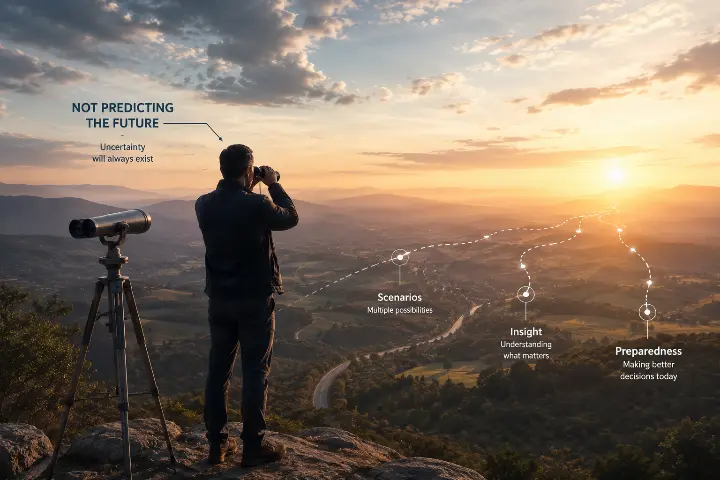
Forecasting Is Not About Predicting the Future
One of the biggest misconceptions about forecasting is that it is designed to predict the future with certainty.
It is not.
Forecasting is about improving preparedness.
A forecast does not tell us exactly what will happen.
It helps us understand what is likely to happen if current trends continue.
More importantly, it helps us identify situations where action may be required before problems become visible in traditional reports.
Good forecasting creates time.
And time is one of the most valuable resources any decision-maker can possess.
The Same Challenge Exists Everywhere
Whether speaking with treasury professionals in international banks, finance teams in corporations, or public sector leaders responsible for community services, the challenge remains remarkably similar.
Resources are limited.
Decisions have consequences.
The future contains uncertainty.
A bank may be asking:
Will our liquidity remain sufficient under stress?
A corporation may be asking:
Will cash flow support planned expansion?
A local government may be asking:
Will future revenues support upcoming projects and commitments?
Different environments.
Different objectives.
The same fundamental question:
"What happens next?"
From Reporting to Decision Intelligence
Traditionally, organizations invested heavily in reporting.
Reporting remains important.
But reporting alone is no longer enough.
The next evolution is moving from reporting toward decision intelligence.
Instead of asking only:
"What happened?"
Organizations increasingly need to ask:
"What is likely to happen?"
"What are the risks?"
"What assumptions matter most?"
"What actions should we consider now?"
The organizations that consistently answer these questions tend to react earlier, plan better, and allocate resources more effectively.
Looking Beyond the Numbers
Forecasting is not merely a mathematical exercise.
It is a decision-making discipline.
A forecast should not sit inside a spreadsheet.
It should become part of a conversation.
A conversation about risks.
A conversation about opportunities.
A conversation about preparedness.
The real value is not the forecast itself.
The value comes from the decisions that the forecast helps improve.
A Forward-Looking Mindset
The future will always contain uncertainty.
No model, technology, or methodology can eliminate that uncertainty entirely.
But organizations can choose how they respond.
They can continue looking primarily at historical results.
Or they can begin building a more forward-looking culture.
A culture that combines experience, data, analysis, and informed judgment to prepare for what comes next.
Because in the end, success rarely belongs to those who explain the past most effectively.
It usually belongs to those who prepare for the future first.
Treasury TradingHub
Helping organizations move from reporting the past to understanding the future.