
Most organizations today are confident in one area:
- Forecasting.
- The processes are in place.
- The numbers are produced.
- The reports are reviewed regularly.
On the surface, everything appears structured and under control.
And yet, when critical decisions arise — particularly under pressure — the conversation often shifts in a different direction.
Uncertainty returns.
The Quiet Gap
A forecast provides an expectation.
It answers a fundamental question:
What is likely to happen?
But decision-making requires more than expectation.
It requires understanding.
- Why is this outcome emerging?
- What are the underlying drivers?
- How sensitive is this projection to change?
- What happens if conditions shift?
- What action should be taken now?
These questions are rarely answered by the forecast itself.
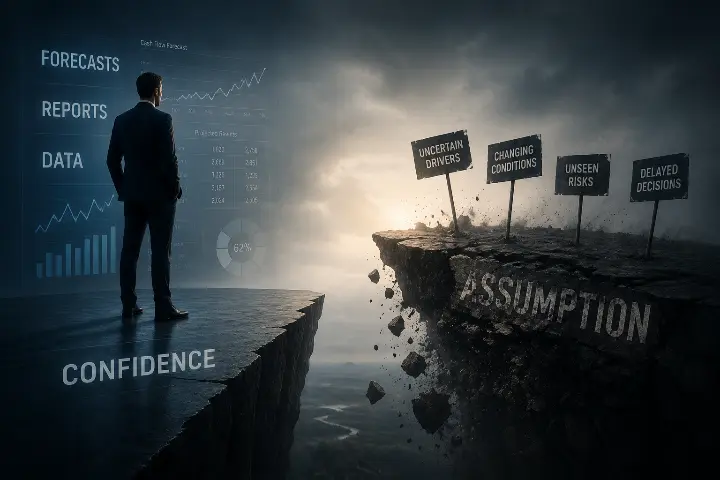
Where Confidence Becomes Assumption
In many environments, the existence of a forecast creates a sense of readiness.
The logic is simple:
We have forward-looking numbers — therefore we are prepared.
But experience suggests otherwise.
- Forecasts are reviewed.
- Variances are discussed.
- Adjustments are made.
Yet decisions often remain:
- reactive
- cautious
- dependent on interpretation rather than clarity
The forecast is present.
Decision confidence is not.
The Difference Between Output and Insight
A forecast is an output.
It reflects data, assumptions, and structure.
Insight is something else entirely.
It connects:
- outcomes to drivers
- projections to risk
- numbers to action
Without this connection, even the most sophisticated forecast remains incomplete.
A Layer That Is Often Missing
What many organizations discover over time is not a lack of data, or even a lack of forecasting capability.
It is the absence of a layer that sits above it.
A layer that translates projections into:
- meaning
- scenarios
- implications
- and ultimately, decisions
This layer does not replace forecasting.
It completes it.
A Simple Reflection
Consider your current environment.
When reviewing a forecast, can you consistently answer:
- What is driving the outcome?
- Where is the real exposure?
- What changes the result most significantly?
- What is the recommended action?
If these answers require additional interpretation, discussion, or intuition, then the forecast — while necessary — is not yet sufficient.
Closing Thought
Forecasting is essential.
But it is not the endpoint.
It is the starting point of something more demanding:
Understanding what the forecast truly means.
The real question is not whether a forecast exists.
It is whether it can be used — confidently — to drive decisions when it matters most.