
Every day, leaders make decisions.
Some involve millions of dollars. Others determine the future direction of a department, an organization, or even an entire industry.
Budgets are approved.
Investments are authorized.
Projects are launched.
Loans are granted.
New markets are entered.
Technology is purchased.
Recruitment plans are approved.
These decisions are often supported by detailed reports, dashboards, forecasts, market intelligence, and increasingly, Artificial Intelligence.
Yet despite having access to more information than ever before, organizations continue to experience failed projects, unexpected liquidity pressures, strategic setbacks, and financial surprises.
Why?
The answer may be simpler than many realize.
Because there are actually two different decisions taking place.
Most organizations only make one.
A Tale of Two Executives
Imagine two Chief Financial Officers.
Both are experienced.
Both receive the same management reports.
Both have capable finance teams.
Both review identical forecasts, budgets, and market analyses.
After weeks of discussion, both approve the same strategic investment.
On paper, the decision is sound.
The numbers make sense.
The risks appear manageable.
The projected returns are attractive.
Six months later, however, their stories begin to diverge.
One organization continues to perform well. Cash flows remain healthy, operations adapt to changing conditions, and management confidently moves forward.
The other organization begins to struggle. Interest costs rise unexpectedly. A major customer delays payments. Supply chain disruptions increase operating expenses. Liquidity becomes tighter than anticipated, forcing management into reactive decisions they never expected to make.
What happened?
Did one management team make a poor decision?
Not necessarily.
The difference was not intelligence, experience, or effort.
The difference was that one organization made a decision.
The other made a resilient decision.
The First Decision
The first decision is the one every organization knows well.
It answers a familiar question:
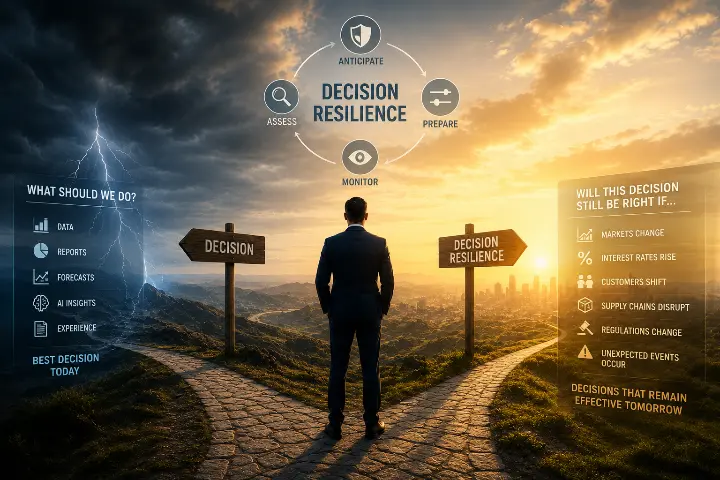
"What should we do?"
Should we approve this investment?
Should we expand?
Should we recruit additional staff?
Should we reduce expenses?
Should we refinance our debt?
Should we acquire another business?
Most management systems are designed to help answer these questions.
Budgets.
Forecasts.
Management reports.
Business Intelligence.
Key Performance Indicators.
Artificial Intelligence.
All of these tools are valuable because they improve our understanding of today's situation.
They help us determine what appears to be the best decision based on the information currently available.
That is important.
But it is only half of the story.
The Second Decision
The second decision asks a very different question.
Instead of asking,
"What should we do?"
it asks,
"Will this still be the right decision if circumstances change?"
This is where Decision Resilience begins.
Consider a few possibilities.
Interest rates increase faster than expected.
Inflation remains elevated.
Exchange rates move sharply.
A key customer is lost.
A supplier fails.
Regulations change.
Unexpected geopolitical events disrupt markets.
The original decision may still have been logical.
Yet the environment surrounding that decision has changed.
A decision that appeared excellent yesterday may no longer be appropriate today.
The issue is not whether management made the wrong decision.
The issue is whether anyone tested how resilient that decision really was.
Why Good Decisions Sometimes Fail
Many organizations judge decisions by whether they were correct at the time they were made.
That is understandable.
Executives can only work with the information available.
However, the business world rarely remains static.
Markets evolve.
Customers change.
Technology advances.
Economic conditions shift.
Unexpected events occur without warning.
A decision can be perfectly reasonable on Monday and require significant adjustment by Friday.
That does not necessarily indicate poor management.
It highlights something much more important.
The organization optimized for making the right decision today.
It did not evaluate whether the decision could survive tomorrow.
Decision Resilience Changes the Conversation
Decision Resilience does not replace forecasting.
It does not replace budgeting.
It does not replace executive judgement.
Instead, it adds another layer of thinking.
Rather than asking only,
"Is this the best decision?"
leaders also begin asking:
- What assumptions are we relying upon?
- What happens if those assumptions prove incorrect?
- How sensitive is this decision to changing conditions?
- How much flexibility do we retain?
- At what point should management reconsider the decision?
- What early warning indicators should we monitor?
These questions do not make decision-making slower.
They make decision-making stronger.
Beyond Better Forecasts
Organizations often invest heavily in improving forecasts.
Better forecasting is valuable.
Artificial Intelligence is making forecasting faster and, in many cases, more accurate.
But even the best forecast cannot eliminate uncertainty.
Forecasts describe what is likely to happen.
They cannot guarantee what will happen.
Decision Resilience accepts this reality.
Instead of trying to predict every possible future perfectly, it prepares organizations to remain effective across multiple possible futures.
That is an important distinction.
Lessons from Recent Years
Recent history has reminded us how quickly business conditions can change.
Interest rates increased after years of stability.
Supply chains experienced unprecedented disruption.
Energy prices fluctuated sharply.
Inflation returned to levels many organizations had not planned for.
Geopolitical tensions created new commercial uncertainties.
Many organizations entered these periods with carefully prepared annual budgets and strategic plans.
There was nothing inherently wrong with those plans.
The environment simply changed faster than expected.
The organizations that adapted most successfully were often those that had already considered alternative scenarios and understood the resilience of their decisions before circumstances changed.
The Next Evolution of Executive Decision Making
Artificial Intelligence is transforming how organizations analyse information.
Data can now be processed faster.
Patterns can be identified more quickly.
Reports can be generated almost instantly.
Insights that once required days of analysis can now appear within minutes.
These advances are significant.
However, Artificial Intelligence should not become the decision-maker.
It should become an enabler of better executive judgement.
The next stage of business intelligence is not simply producing smarter reports.
It is combining intelligent analysis with structured resilience thinking before major decisions are implemented.
This is where executive experience, governance, scenario analysis, and resilience come together.
Looking Ahead
As organizations continue to navigate increasingly complex environments, the ability to make decisions will no longer be enough.
Success will increasingly depend on the ability to make decisions that remain effective as conditions evolve.
Decision Resilience is not about eliminating uncertainty.
Uncertainty is part of business.
Instead, it is about preparing organizations to perform confidently despite that uncertainty.
Perhaps that is the real evolution of executive decision-making.
Not simply making better decisions.
But making decisions that continue to work.
Learn More
If this perspective resonates with your organization and you would like to explore how Decision Resilience can strengthen planning, governance, forecasting, treasury, and executive decision-making, we would be pleased to hear from you.
Email: peter@treasury-tradinghub.com
Treasury TradingHub SaaS Overview:
https://treasury-tradinghub.com/saas-overview/
Treasury TradingHub develops AI-assisted decision intelligence solutions that help banks, corporations, and government organizations strengthen forecasting, scenario analysis, financial intelligence, governance, and decision resilience.