
Organizations today have no shortage of information.
Financial reports arrive every month.
Budgets are prepared.
Dashboards are updated.
KPIs are monitored.
Yet despite all of this information, many important decisions are still based largely on experience, intuition, or assumptions.
That is not because leaders lack expertise.
It is because most systems were designed to tell us what has already happened—not what is most likely to happen next.
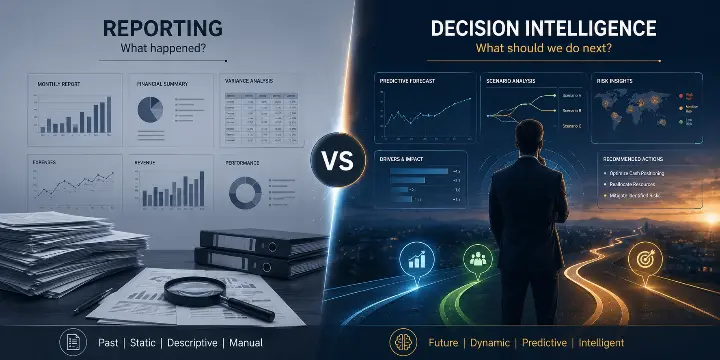
The Difference Between Reporting and Decision Intelligence
Traditional reporting answers questions such as:
- What happened?
- What was the variance?
- Which department overspent?
- How did revenue perform?
These are important questions.
But they are retrospective.
Decision Intelligence asks different questions.
- What is likely to happen if current trends continue?
- Which assumptions have the greatest influence on future outcomes?
- What risks are emerging before they become visible in financial statements?
- Which decision produces the strongest long-term outcome under uncertainty?
Those questions require a different way of thinking.
A Different Perspective
During recent discussions with local government leaders, one theme became very clear.
Most organizations already possess enormous amounts of data.
The challenge is rarely collecting more information.
The challenge is transforming existing information into better decisions.
This is where true differentiation begins.
Organizations do not become more resilient because they purchase another system.
They become more resilient because they improve the quality, consistency, and transparency of their decision-making.
From Information to Insight
Imagine being able to move beyond simple reports.
Instead of seeing only a budget variance, you understand the drivers behind it.
Instead of viewing historical cash balances, you can forecast future liquidity under multiple scenarios.
Instead of reacting to financial anomalies, you identify them before they become significant issues.
Instead of relying on assumptions, you evaluate alternative strategies using structured scenario analysis.
That changes the conversation completely.
Leadership discussions become less about explaining yesterday and more about preparing for tomorrow.
Why Differentiation Matters
Many organizations purchase similar software.
Many use similar accounting systems.
Many produce similar reports.
Technology alone rarely creates competitive advantage.
The real differentiator is the organization's ability to make consistently better decisions than others facing exactly the same environment.
That capability becomes increasingly valuable in periods of uncertainty.
Economic volatility.
Funding pressures.
Changing regulations.
Rapid technological change.
These challenges cannot be solved by reports alone.
They require informed decision-making supported by structured analysis.
Looking Forward
Artificial Intelligence should not replace professional judgement.
It should strengthen it.
Forecasting, scenario analysis, anomaly detection, risk assessment, and decision simulation are not ends in themselves.
They exist to help leaders ask better questions, evaluate better options, and make better-informed decisions.
That is the future of financial management.
Not simply more data.
Not simply more dashboards.
But better decisions.
Because in the end, organizations are rarely defined by the information they possess.
They are defined by the decisions they make.
Treasury TradingHub
We believe the future is not about replacing existing systems. It is about adding an intelligence layer that helps governments, financial institutions, and corporations transform data into informed, transparent, and resilient decisions.
Because better decisions build stronger organizations.