
Different Industries. Similar Decisions.
For decades, organizations have invested in software designed specifically for their industry. Banks implemented treasury systems. Governments adopted budgeting and case management platforms. Utilities invested in project finance and asset management solutions. Corporates relied on ERP, CRM and financial applications.
While these systems manage day-to-day operations effectively, executives continue to face the same fundamental challenge: making better decisions from increasingly complex information.
The Executive Challenge Is Universal
Whether leading a bank, a government agency, a utility company, a university or a private enterprise, senior leaders consistently ask similar questions:
What is happening?
Why is it happening?
What is likely to happen next?
What risks should we be concerned about?
Which decision will deliver the best outcome?
These are not banking questions, government questions or utility questions.
They are executive questions.
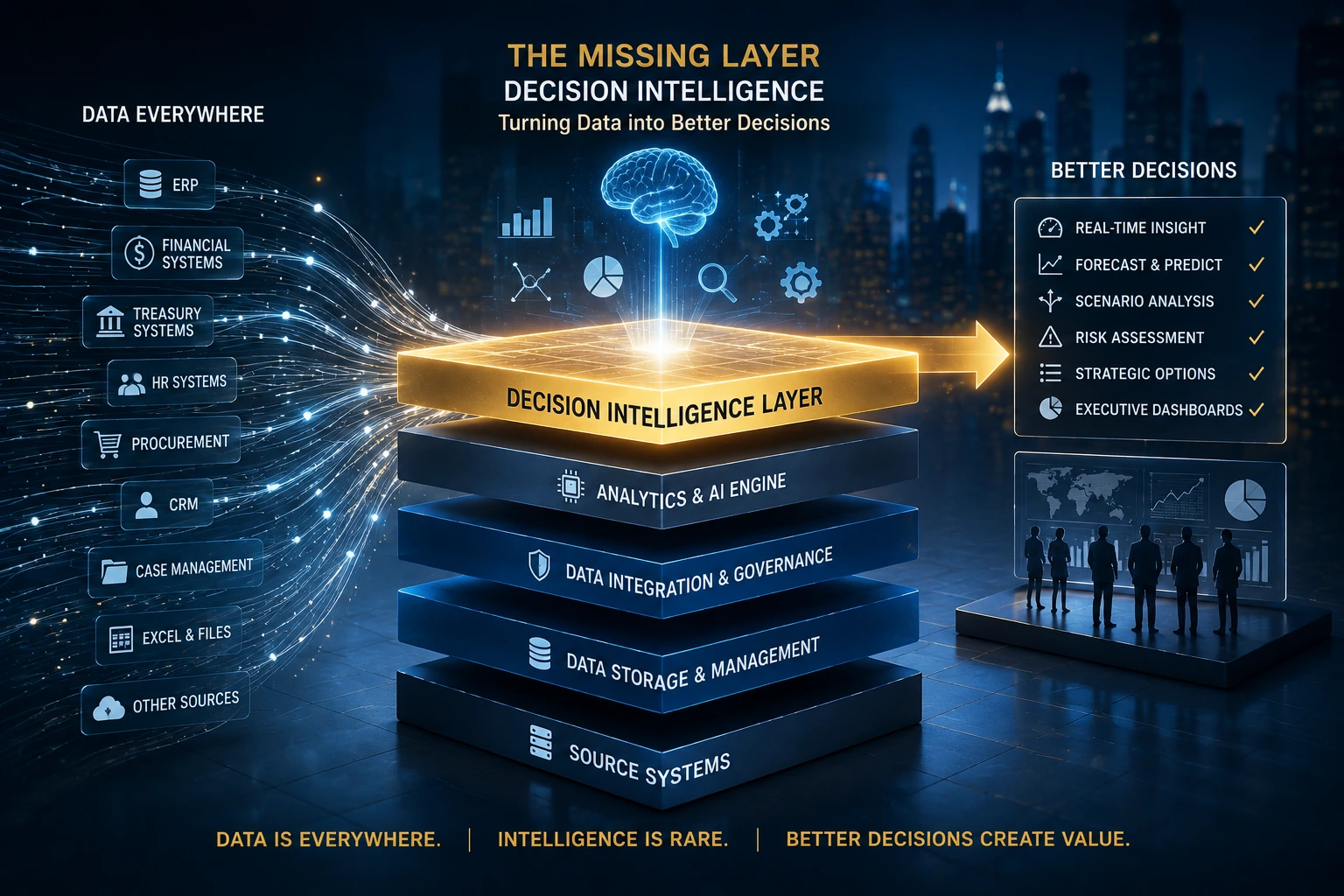
The Missing Layer
Most organisations already possess the systems needed to record transactions and manage operations. What is often missing is an intelligent layer that transforms operational data into meaningful executive insights.
Decision Intelligence bridges that gap by combining forecasting, scenario analysis, AI-assisted summaries, executive dashboards and performance analytics into information that supports strategic decision-making.
Rather than replacing existing systems, it complements them.
One Platform, Many Industries
This is where scalability becomes particularly interesting.
The same Decision Intelligence capabilities can be configured to support very different organizations.
A bank may focus on liquidity forecasting and treasury risk.
A government agency may require budget planning, operational performance and executive reporting.
A utility company may prioritise project finance, capital investment and infrastructure planning.
A labour department may analyse case volumes, staffing requirements and service performance.
Although the operational data differs, the underlying executive questions remain remarkably similar.
Building Once, Configuring Many Times
The future of enterprise software may not be about creating entirely new applications for every industry. Instead, it may be about developing intelligent platforms that can be configured to address different business environments while leveraging a common technology foundation.
This approach enables organisations to benefit from proven analytical capabilities while adapting the platform to their own operational requirements, terminology and workflows.
Looking Ahead
Decision Intelligence is not limited to a single industry or business function. It represents a new way of helping organizations transform data into better decisions.
As technology continues to evolve, the organizations that gain the greatest advantage may not be those with the most software, but those that are able to convert information into timely, informed and confident executive decisions.
Contact us for more information